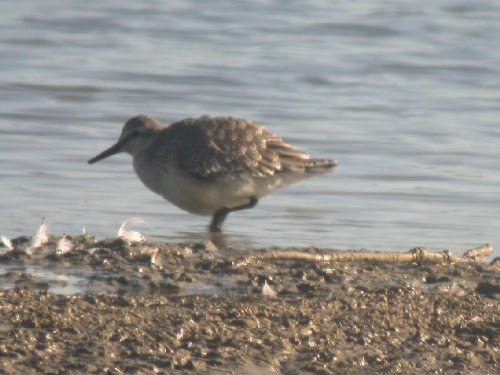
Very misty with somewhat poor visibility for a few hours after dawn. Dave Bilcock texted to say that he had seen two LITTLE STINTS at Wilstone, so I made my way straight over......
As DB had implied, Wilstone was really in great shape and very attractive for birds. With work to be carried out again on the vegetation on the banks, the water level is dropping daily and extensive mud is now on show. Although the earlier RUFF had departed after just a short while, I was very pleased after missing the weekend Red Knot to finally add a new bird in late September - the LITTLE STINTS...
Both juvenile birds were still present and showing very well just to the left (north) of the Drayton Hide. Dave Hutchison managed to obtain an excellent image of one of the birds and on Wednesday and Thursday, a singleton remained.
The first 26 EUROPEAN GOLDEN PLOVERS of the autumn also arrived and were roosting on the central spit but most impressive was the 14 NORTHERN PINTAILS - the flock including one adult drake.
FULL LIST
The juvenile BLACK-NECKED GREBE was still present, favouring between the jetty and the Drayton Bank. Little Grebe (1 still present) Great Crested Grebe (11) WHOOPER SWANS (both adults still present) Common Teal (196) GARGANEY still present Eurasian Wigeon (57) Gadwall (24) Shoveler (82) Northern Pochard (204) Lapwing (74) Common Kingfisher (3) Pied Wagtail (2) Grey Wagtail (1) Goldcrest (5 in North Hedgerow)
Chinese Water Deer (1)
STARTOP'S END RESERVOIR (HERTS)
A massive influx of wildfowl with a full inventory logging 15 Great Crested Grebe, 15 Mute Swans, 15 Teal, 34 Shoveler, 226 Tufted Duck, 93 Northern Pochard and the two continuing RED-CRESTED POCHARDS.
Light NE winds and light drizzle is what befell my visit to the reservoirs today and there was little in the way of interest apart from a major build up in wildfowl numbers.
WILSTONE RESERVOIR (HERTS)
Great Crested Grebe (12) Little Grebe (1) *BLACK-NECKED GREBE (juvenile still present to the east of the Drayton Bank) Mute Swan (27 including the lone first-year) Gadwall (24) Common Teal (297) Eurasian Wigeon (57) Shoveler (122) NORTHERN PINTAIL (5) Tufted Duck (117) Northern Pochard (204) Lapwing (104) Grey Wagtail House Martin (4)
An astounding 4 GREY PLOVERS over at 16:30 heading East towards College lake.
The Garganey and Black-necked Grebe are both still present as well as a single Common Sandpiper, but no sign of the earlier Spot'shank seen by Francis Buckle.
Yesterday evening a Dunlin and 2 Yellow Wagtails were at Startops.
No sign of the Red Knot Saturday afternoon but an adult YELLOW-LEGGED GULL was amongst ca.15 LBB resting on the mud between the hide and overflow. A Common Gull was also present with the BHGs. The GARGANEY was showing well in front of the hide and the juvenile BLACK-NECKED GREBE distantly off the jetty.
Myself and Roy Hargreaves initially watched the RED KNOT fly in and land amongst the Coots on the recently exposed spit opposite the car park steps, before it relocated to the mud just off the old overflow (David Bilcock).
I have been birding since 1969 but became obsessed with 'twitching' in 1974 and haven't looked back since. Have driven over 1.3 million miles in pursuit of rare birds in the UK, where to date I have recorded 588 species in Britain and Ireland. I also have a fascination for the Birds of the Western Palearctic, where I have currently recorded 880 of the 1,064 species ever recorded. I am widely travelled in North America, as well as in Africa and Asia, and have written at least 29 books on my chosen subject, including best-sellers ''Ultimate Site Guide to Scarcer British Birds' and 'Rare Birds in Britain 1800-1990'. Established the UK400 Club in 1981 to cater for the most obsessive of the British birding fraternity and now concentrate on online publishing, via the www.uk400clubonline.co.uk website. Record Birding achievements include recording 386 species in Britain & Ireland in 1996 and 627+ in the Western Palearctic in 2008